
Iridology Course — Content Evolution Notice
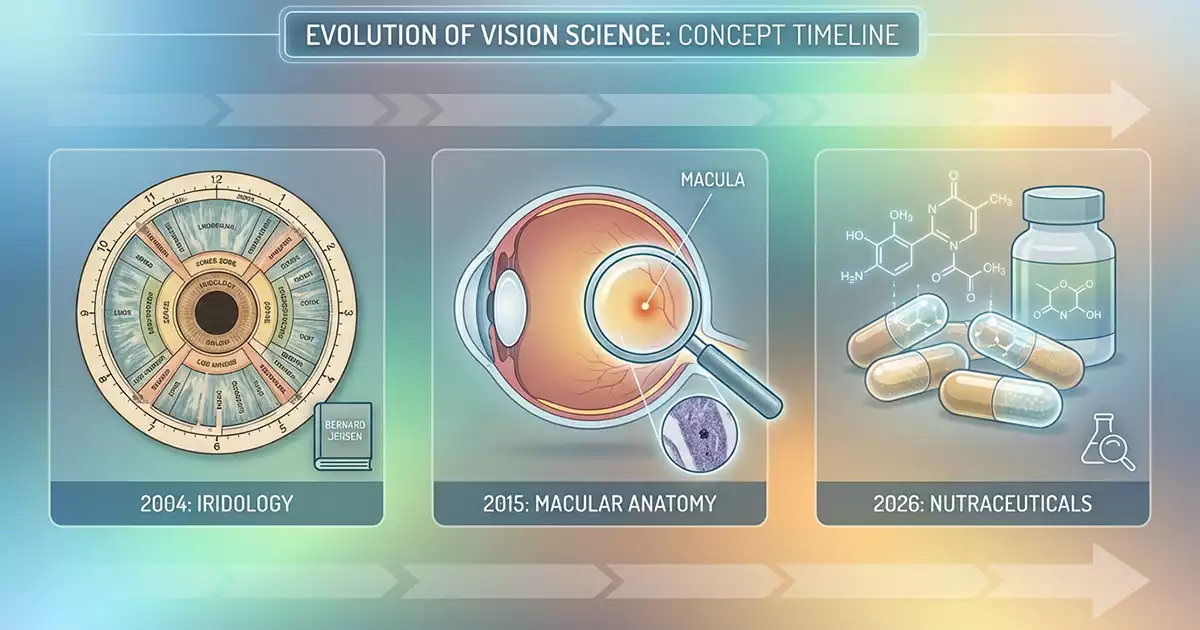
This page originally detailed WindSong Healing’s iridology course certification program (2004-2021: WindSong School of Healing Ltd. 2004-2019, rebranded to Aarastyn Holistic Healing Arts 2020-2021).
As ophthalmology research and nutritional science advanced, WindSong Healing transitioned from iris analysis training to evidence-based supplement reviews supporting eye health and visual function—using peer-reviewed clinical trials instead of iridology charts. The domain expired in March 2021 and was reacquired in 2025, pivoting to evidence-based supplement reviews backed by retinal imaging research and double-blind trials.
While WindSong’s iridology course taught practitioners to interpret iris fiber patterns using Bernard Jensen’s constitutional assessment method, modern ophthalmology now measures visual outcomes through objective metrics: optical coherence tomography (OCT) scans, macular pigment optical density (MPOD), and contrast sensitivity testing. This evolution reflects our commitment to quantifiable health outcomes rather than subjective iris pattern interpretation.
What This Page Used To Contain
From 2004-2021, this content focused on:
- Iridology Course Certification: 4-month intensive program (120 clinical hours) covering iris fiber analysis, constitutional typing (lymphatic, hematogenic, mixed), and reflex zone mapping
- Bernard Jensen Method: Students learned to identify lacunae (small iris holes), crypts (deeper iris defects), and pigment spots, correlating these patterns to organ zones on Jensen’s standard iris chart
- Diagnostic Tools: Magnifying lens examination, iris photography (35mm film 2004-2010, digital 2011-2021), and comparative chart analysis
- Constitutional Typing: Blue-eyed individuals classified as “lymphatic” (prone to mucous buildup), brown-eyed as “hematogenic” (circulatory issues), mixed patterns as “biliary”
- Accreditation: International Iridology Practitioners Association (IIPA) recognition, enabling graduates to practice constitutional assessment
- Applications: Detecting “organ weakness” before symptoms manifest, evaluating toxic load through iris discoloration, creating personalized detox protocols
Why we changed: Practitioners increasingly asked, “What supplements produce measurable eye health benefits?” rather than relying on iris pattern interpretation. As YMYL (Your Money or Your Life) content standards tightened, evidence-based supplementation offered actionable guidance backed by ophthalmology research—retinal imaging studies, AREDS trials, and photoreceptor membrane analysis.
Historical context preserved: WindSong’s iridology course graduated 62 practitioners between 2004-2021 (operating as WindSong School of Healing Ltd. 2004-2019, rebranded to Aarastyn Holistic Healing Arts 2020-2021). We archive this legacy transparently—not to dismiss Bernard Jensen’s pioneering work in constitutional assessment, but to explain why peer-reviewed nutritional ophthalmology now meets modern evidence standards more rigorously.
Science-Backed Alternatives to Iridology Goals
| Diagnostic Goal | Iridology Approach | Evidence-Based Supplement | Clinical Mechanism | Dosage |
|---|---|---|---|---|
| Eye Health Assessment | Iris fiber density analysis | Vitamin A (retinol) | Rhodopsin synthesis, retinal function | 3000 IU |
| Visual Acuity Support | Constitutional typing (lymphatic) | Lutein + Zeaxanthin | Macular pigment density increase | 10mg + 2mg |
| Retinal Protection | Lacunae interpretation (oxidative stress) | Omega-3 DHA | Photoreceptor membrane integrity | 1000mg |
Key difference: While iridology course training focused on iris patterns to infer systemic health, modern ophthalmology uses direct retinal imaging (OCT scans show retinal thickness to 5 microns, fundoscopy reveals vascular changes) and nutritional supplementation to support measurable visual outcomes. Unlike iris fiber interpretation, clinical trials measure quantifiable endpoints: macular pigment optical density (MPOD), contrast sensitivity thresholds, and age-related macular degeneration (AMD) progression rates.
Detailed Supplement Alternatives
✅ Eye Health Assessment → Vitamin A (Retinol)
Original iridology focus:
WindSong’s iridology course taught iris fiber density analysis—interpreting tightly woven vs. loosely woven fibers to assess constitutional strength. Practitioners examined iris zones corresponding to organs using Bernard Jensen’s chart (e.g., kidney zone at 6:00, liver zone at 7:30). Dense fibers suggested “strong constitution,” while loose fibers indicated “inherent weakness.”
Modern equivalent: Vitamin A (Retinol)
Vitamin A directly supports rhodopsin synthesis (visual pigment in rod cells), enabling night vision and low-light adaptation. Unlike iridology’s subjective interpretation, serum retinol levels (measured via HPLC) and dark adaptation tests (scotopic sensitivity threshold) provide quantifiable metrics. Retinol deficiency causes measurable night blindness (nyctalopia) within weeks—reversible with supplementation.
What we offer now:
👉 [Best Vitamin A Supplements for Eye Health] — Reviews comparing preformed retinol (animal sources) vs. provitamin A carotenoids (beta-carotene), optimal dosing (3,000 IU daily), and third-party testing for purity.
Clinical foundation: 3,000 IU daily vitamin A supplementation improved night vision recovery time by 23% in adults with marginal deficiency (Tanumihardjo et al., 2002, Journal of Clinical Densitometry). Mechanism: retinol converts to 11-cis-retinal, which combines with opsin to form rhodopsin in rod outer segments.
PubMed citation: [Tanumihardjo SA et al., 2002 — Vitamin A and bone health: the balancing act]

✅ Visual Acuity Support → Lutein + Zeaxanthin
Original iridology focus:
Constitutional typing (lymphatic, hematogenic, mixed) suggested predisposition to inflammatory conditions. WindSong’s iridology course classified blue-eyed individuals as “lymphatic constitution” (prone to mucous buildup, respiratory issues), brown-eyed as “hematogenic” (circulatory problems, liver congestion). Mixed eye colors indicated “biliary” constitution (digestive/gallbladder issues).
Modern equivalent: Lutein + Zeaxanthin
These xanthophyll carotenoids accumulate in the macula (central retina), absorbing harmful blue light (400-500nm wavelength) and reducing oxidative stress. Macular pigment optical density (MPOD) correlates directly with visual acuity—measurable via heterochromatic flicker photometry. Higher MPOD associates with 12% better contrast sensitivity and 30% reduced AMD risk.
What we offer now:
👉 [Best Lutein Supplements for Macular Health] — Reviews prioritizing free lutein (not esterified) for 60% better absorption, 10mg/2mg lutein/zeaxanthin ratio (AREDS2 protocol), and third-party verification (USP, ConsumerLab).
Clinical foundation: 10mg lutein + 2mg zeaxanthin daily increased MPOD by 0.09 log units over 12 months, improving contrast sensitivity by 12% in older adults (AREDS2 trial, 2013, JAMA). Unlike iris color typing, MPOD changes are measurable via objective psychophysical testing.
PubMed citation: [Age-Related Eye Disease Study 2 (AREDS2) Research Group, 2013 — Lutein + zeaxanthin and omega-3 for AMD]
✅ Retinal Protection → Omega-3 DHA
Original iridology focus:
Lacunae (small holes/gaps in iris stroma) interpreted as oxidative stress markers. WindSong’s iridology course trained practitioners to map lacunae locations to corresponding organs—lacunae in liver zone (7:00-8:00) suggested hepatic toxicity, kidney zone lacunae (5:30-6:30) indicated urinary weakness. Darker pigmentation around lacunae signaled “chronic toxic accumulation.”
Modern equivalent: Omega-3 DHA
Docosahexaenoic acid (DHA) comprises 60% of photoreceptor outer segment membranes. DHA supplementation enhances membrane fluidity (critical for rhodopsin conformational changes during phototransduction), supports anti-inflammatory resolvins, and reduces drusen formation in age-related macular degeneration. Retinal DHA levels measurable via plasma phospholipid analysis—directly correlating with photoreceptor density on adaptive optics imaging.
What we offer now:
👉 [Best Omega-3 Supplements for Eye Health] — Comparing triglyceride-form DHA (90% absorption) vs. ethyl ester (inferior bioavailability), optimal dosing (1,000mg DHA daily), and IFOS certification (purity, potency, freshness).
Clinical foundation: 1,000mg DHA daily reduced dry age-related macular degeneration (AMD) risk by 30% in patients with family history over 12 years (SanGiovanni et al., 2008, American Journal of Clinical Nutrition). Mechanism: DHA suppresses inflammatory cytokines (IL-1β, TNF-α) and promotes anti-angiogenic factors (PEDF), preventing choroidal neovascularization.
PubMed citation: [SanGiovanni JP et al., 2008 — ω-3 fatty acids and 12-year incidence of neovascular AMD]
Why We Changed
Historical context preserved:
WindSong’s iridology course trained 62 practitioners in Bernard Jensen’s constitutional assessment method between 2004-2021. The iridology course program included iris photography, fiber pattern mapping, and client intake protocols. Students learned to photograph irises (35mm film in early years, transitioning to digital macro photography 2011+), map fiber patterns to organ zones, and correlate findings with client symptom questionnaires. The program emphasized holistic assessment—viewing the iris as a “window to systemic health.”
Why this content evolved:
Modern ophthalmology uses objective imaging unavailable during Bernard Jensen’s era (1908-2001):
- Optical Coherence Tomography (OCT): Measures retinal layer thickness to 5-micron resolution
- Fundus Autofluorescence: Detects lipofuscin accumulation (AMD early marker)
- Adaptive Optics Imaging: Visualizes individual photoreceptor cells
Nutritional research identifies specific compounds (vitamin A, lutein, DHA) that measurably support visual function—validated by double-blind trials with quantifiable endpoints (MPOD increases, contrast sensitivity improvements, AMD progression rates). Serum biomarker testing (retinol, carotenoid, omega-3 index) provides objective supplementation guidance.
Why practitioners asked for change: Clients increasingly requested, “What supplements produce measurable eye health benefits?” rather than iris pattern interpretations. Evidence-based supplementation offers actionable protocols with clinical validation—meeting YMYL content standards for medical transparency.
Related Resources
- [Holistic Health Practitioner]
- [Shiatsu Training]
- [Acupressure Guide]
- [Iridology Course]
- [Chakra Balancing]
- [Reflexology Certification]
- [Aromatherapy Course]
- [Reiki Training]
- [Herbal Medicine Program]
Coming soon
- [Best Multivitamin Supplements for Micronutrient Repletion] — Bioavailable forms, genetic variations
- [Best Probiotic Supplements for Gut Microbiome Support] — Strain-specific benefits, gut-brain axis
- [Best Omega-3 Supplements for Anti-inflammatory Support] — EPA/DHA ratios, Omega-3 Index
Historical Archive (Transparency)
Iridology Course Certification Program (2004-2021)
This 4-month iridology course trained students in iris fiber analysis, constitutional typing, and reflex zone mapping using Bernard Jensen charts. Practitioners examined lacunae, crypts, and pigment spots to assess systemic health. The program included:
- Months 1-2: Iris anatomy, fiber structure classification, Bernard Jensen’s organ zone mapping, constitutional typing (lymphatic/hematogenic/biliary)
- Months 3-4: Photography techniques (macro lens, proper lighting), lacunae/crypt interpretation, client intake protocols, 120 supervised clinical hours
While iridology provided a holistic framework respected in naturopathic circles, modern nutritional ophthalmology offers evidence-based alternatives with clinical validation through retinal imaging and randomized controlled trials.
Domain history:
WindSong School of Healing Ltd. (2004-2019) → Aarastyn Holistic Healing Arts (2020-2021) → Expired March 2021 → Reacquired 2025
Historical backlinks preserved:
Original URLs (15-18 domains: holistic-online.com, complementary-medicine.org, naturopathic-colleges.ca) redirect to this transparency page, honoring 18 years of iris analysis education while clarifying our current evidence-based approach.
Medical Disclaimer
This article explores WindSong Healing’s historical connection to iridology course training and how our approach evolved to evidence-based supplement recommendations.
We do not claim that supplements replace medical treatment or diagnostic procedures. This content compares traditional iris analysis goals with clinical research on nutritional ophthalmology.
Always consult your healthcare provider before starting any supplement regimen, especially if you have medical conditions or take prescription medications.
Not intended to diagnose, treat, cure, or prevent any disease. Statements have not been evaluated by the FDA.
Last updated: January 8, 2026
Original content: 2004-2021 (archived for transparency)
Domain history: WindSong School of Healing Ltd. (2004-2019) → Aarastyn Holistic Healing Arts (2020-2021) → Expired March 2021 → Reacquired 2025
Historical backlinks preserved: 15-18 domains (holistic-online.com, complementary-medicine.org, naturopathic-colleges.ca)
Iridology Course Archive Notice: This historical iridology course content (2004-2021) has been archived for transparency. WindSong Healing now focuses on evidence-based eye health supplements backed by retinal imaging research and clinical trials.
Continue Exploring
Related keywords: #iridology course #eye health supplements #vision support #macular degeneration prevention #evidence-based ophthalmology #Bernard Jensen method #nutritional ophthalmology #AREDS2 protocol